choices (9)


An MIT team proved that it is impossible to get information about correlations from two-way comparisons alone. Correlations can be discerned, however, when large numbers of people rate three alternatives in their order of preference.

Decision Theory is the study of principles and algorithms for making correct decisions—that is, decisions that allow an agent to achieve better outcomes with respect to its goals. Every action at least implicitly represents a decision under uncertainty: in a state of partial knowledge, something has to be done, even if that something turns out to be nothing (call it "the null action"). Even if you don't know how you make decisions, decisions do get made, and so there has to be some underlying mechanism. What is it? And how can it be done better? Decision theory has the answers. Note: this page needs to be updated with content regarding Functional Decision Theory, the latest theory from MIRI. Related: Game Theory, Robust Agents, Utility Functions A core idea in decision theory is that of expected utility maximization, usually intractable to directly calculate in practice, but an invaluable theoretical concept. An agent assigns utility to every possible outcome: a real number representing the goodness or desirability of that outcome. The mapping of outcomes to utilities is called the agent's utility function. (The utility function is said to be invariant under affine transformations: that is, the utilities can be scaled or translated by a constant while resulting in all the same decisions.) For every action that the agent could take, sum over the utilities of the various possible outcomes weighted by their probability: this is the expected utility of the action, and the action with the highest expected utility is to be chosen. Thought experiments The limitations and pathologies of decision theories can be analyzed by considering the decisions they suggest in the certain idealized situations that stretch the limits of decision theory's applicability. Some of the thought experiments more frequently discussed on LW include: * Newcomb's problem * Counterfactual mugging * Parfit's hitchhiker * Smoker's lesion * Absentminded driver * Sleeping Beauty problem * P
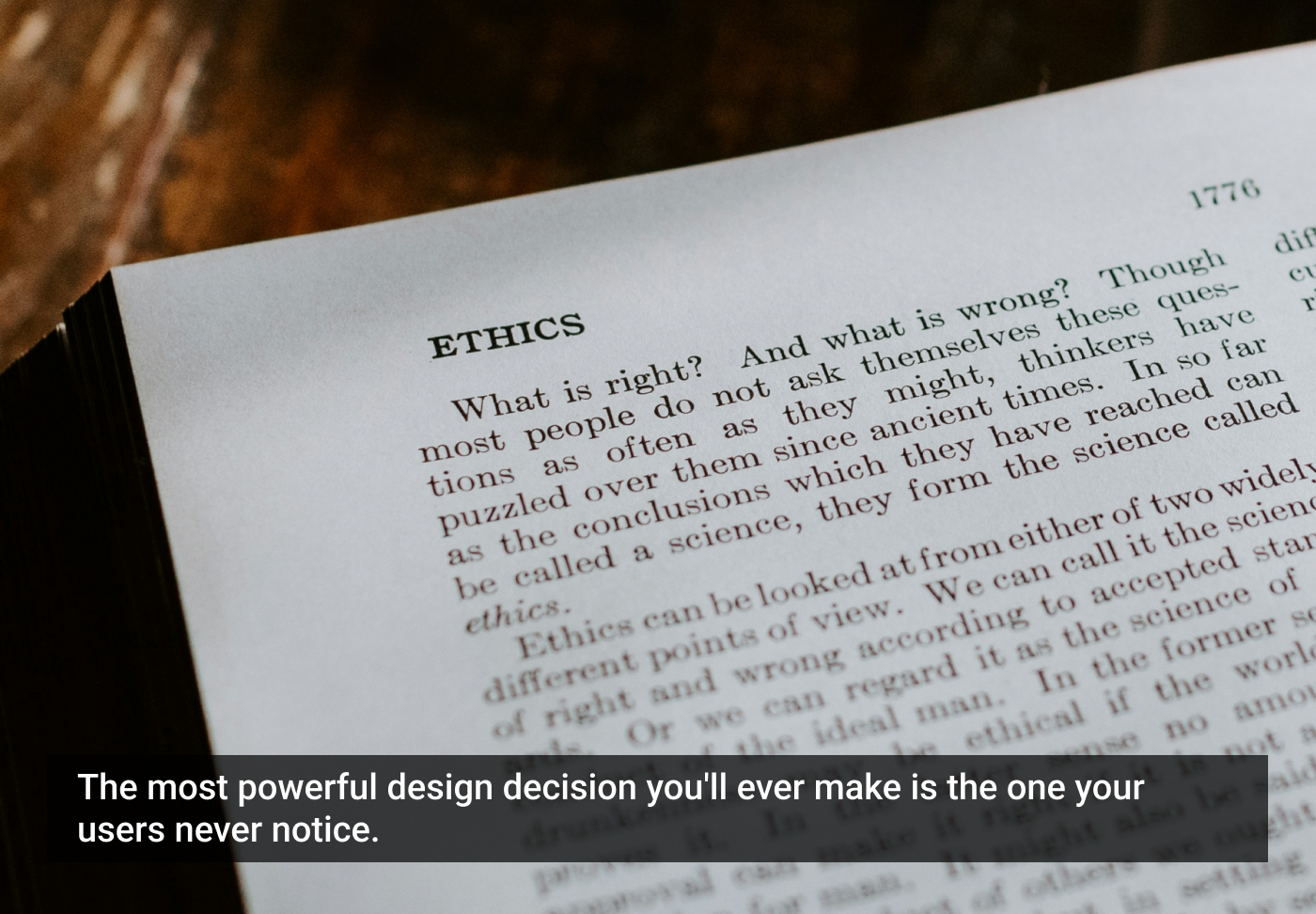
In our increasingly digitized world, design is no longer just about beauty and usability — it’s about responsibility. Every checkbox ticked by default, every pre-selected plan, and every silent subscription carries a weight that goes beyond UI — it reflects the ethical stance of the designer. This article reminds us that defaults are more than technical settings — they’re ethical decisions. As designers, the real takeaway is this: our silent choices often speak the loudest. In your next project, before leaving a checkbox pre-selected, ask yourself — who does this really serve?

Retailers have long assumed that the bigger the range, the happier the customer. Endless shelves, multiple variants, and every possible option should, in theory, increase satisfaction. Yet the evidence is more nuanced. Recent research shows that in some contexts, larger assortments can increase hesitation and reduce conversion, while in others the effect is muted. Overload […]

The Gruen Transfer is taking over social media. What is it and how can we avoid it?

Have you ever stopped to think about just how many decisions you make each and every day? Some choices are very simple, such as choosing to get up in the

Nautilus is a different kind of science magazine. Our stories take you into the depths of science and spotlight its ripples in our lives and cultures.

Pandora CTO Tom Conrad explains how Pandora picks the most important features to build with its limited engineering power.