nvidia

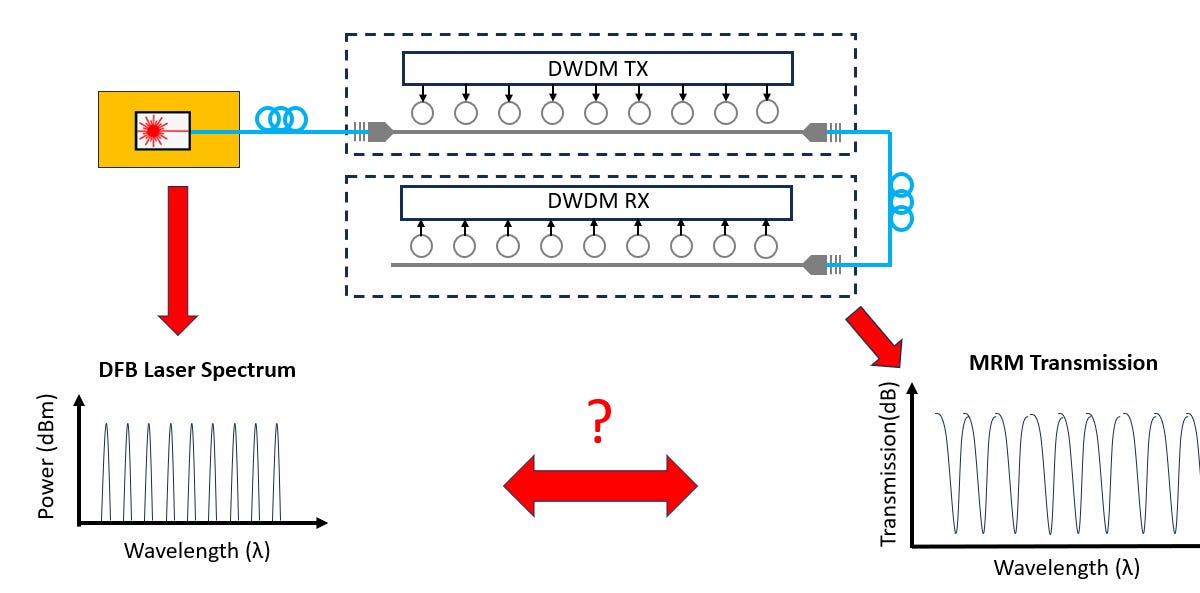
Key physics constraints and architecture challenges for scaling data rates in DWDM - ring modulator physics, clocking, CW-DFB Laser, and package integration

According to benchmark platform Artificial Analysis, Nvidia's new Nemotron 3 Ultra is the most capable open AI model from the US to date.
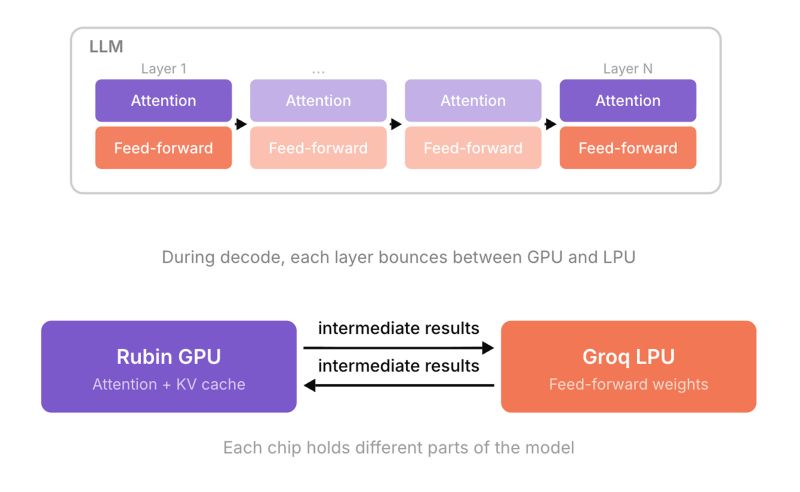
why did NVIDIA cancel the Rubin CPX and replace it with a Groq LPU? LLM inference has two phases. prefill processes the whole prompt at once and is compute-bound. decode generates one token at a time and is memory-bound, reading the full model weights and KV cache for every token. since 2024 the standard approach has been splitting these onto separate GPU pools so prefill and decode stop interfering with each other. NVIDIA's first hardware answer was the Rubin CPX, announced September 2025. a dedicated prefill chip with 128 GB of GDDR7 memory, over 50% cheaper per GB than HBM, under 800W, more chips per rack. prefill is compute-bound, so save the expensive HBM for decode. the savings were real, but regular Rubin GPUs also handle prefill well enough. six months later at GTC 2026, NVIDIA shelved the CPX and partnered with Groq on a completely different split. Groq's split happens inside each layer. every transformer layer has an attention block that reads the KV cache and a feed-forward block that reads only its own weights. the KV cache is tens of gigabytes and is stored in HBM on the GPU. the feed-forward weights are smaller and read the same way every token. that second property is the reason SRAM works here. the Groq LP30 has 500 MB of on-chip SRAM at 150 TB/s, about 20x the memory bandwidth of a B200's HBM3e. run feed-forward on the LP30, keep attention on the GPU, and pass intermediate results between them at every layer. NVIDIA calls it Attention-FFN Disaggregation. the LPX rack packs 256 LP30 chips for 128 GB of SRAM and 40 PB/s aggregate bandwidth, with 640 TB/s of chip-to-chip interconnect for the per-layer transfer. NVIDIA claims 35x more inference throughput per megawatt than GB200 NVL72. so the short answer: the CPX saved cost on prefill, where regular GPUs were already fine. AFD delivers 20x bandwidth on decode by splitting inside the layer, where the real bottleneck sits. different axis, bigger win. wrote up the full details on the blog with diagrams for each approach, plus the AWS + Cerebras split where Trainium handles prefill and a wafer-scale CS-3.

Nvidia researchers developed dynamic memory sparsification (DMS), a technique that compresses the KV cache in large language models by up to 8x while maintaining reasoning accuracy — and it can be retrofitted onto existing models in hours.

NVIDIA is formally announcing its Rubin AI platform today which will be the heart of next-gen Data Centers, with a 5x upgrade over Blackwell.

Nvidia announced the Rubin CPX, a solution that is specifically designed to be optimized for the prefill phase, with the single-die Rubin CPX heavily emphasizing compute FLOPS over memory bandwidth…

NVIDIA has surprisingly unveiled a rather 'new class' of AI GPUs, featuring the Rubin CPX AI chip that offers immense inferencing power.

NVIDIA has provided an in-depth look at its fastest chip for AI, the Blackwell GB300, which is 50% faster than GB200 & packs 288 GB memory.

Nvidia quietly launched a groundbreaking AI model that surpasses OpenAI’s GPT-4 and Anthropic’s Claude 3.5, signaling a major shift in the competitive landscape of artificial intelligence.

So, when I suspend my laptop, then wake it up later, my laptop does turn on, I'm able to, for example, turn up and down the volume with audio confirmation using the kepboard, but my screen remains ...

This post is the seventh installment of the series of articles on the RAPIDS ecosystem. The series explores and discusses various aspects of RAPIDS that allow its users solve ETL (Extract, Transform…
See how to build end-to-end NLP pipelines in a fast and scalable way on GPUs — from feature engineering to inference.

In this post we take a look at how to use cuDF, the RAPIDS dataframe library, to do some of the preprocessing steps required to get the mortgage data in a format that PyTorch can process so that we…

Historically speaking, processing large amounts of structured data has been the domain of relational databases. Databases, consisting of tables that can be joined together or aggregated…

This series on the RAPIDS ecosystem explores the various aspects that enable you to solve extract, transform, load (ETL) problems, build machine learning (ML) and deep learning (DL) models…

Nvidia has released NVLM 1.0, a powerful open-source AI model that rivals GPT-4 and Google’s systems, marking a major breakthrough in multimodal language models for vision and text tasks.