🧮 Partial Differential Equations: When Change Happens in More Than One Direction
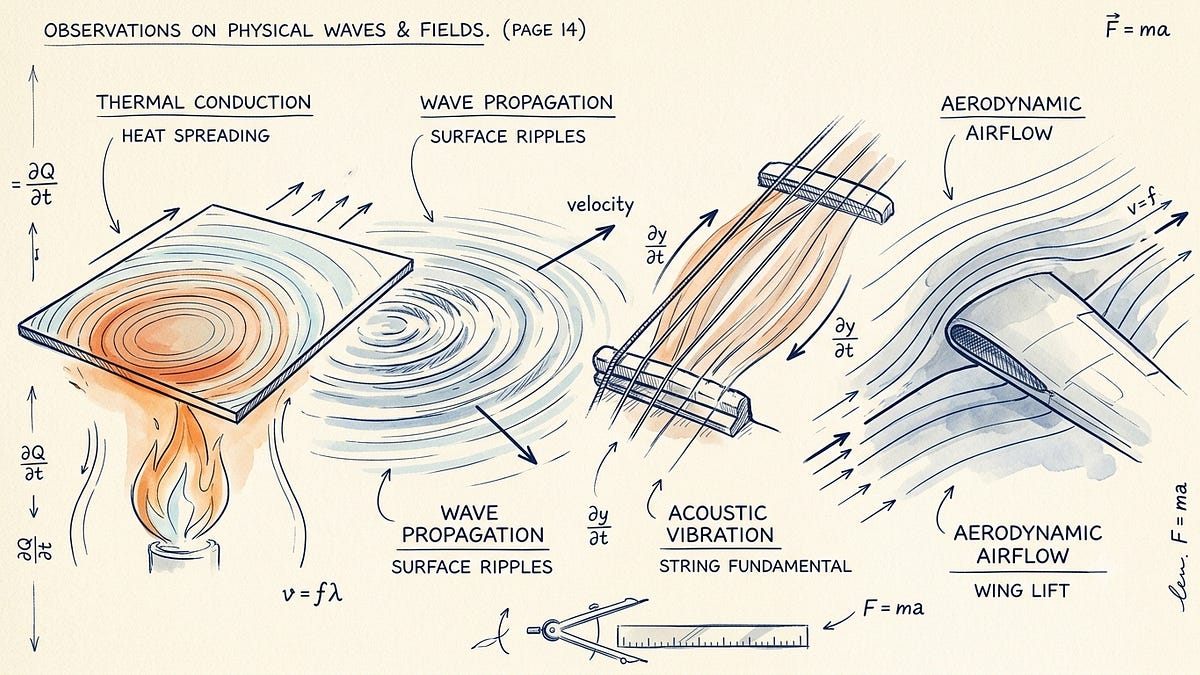
📍 The Mathematics Behind Heat, Waves, Fluids and Modern Engineering
📍 The Mathematics Behind Heat, Waves, Fluids and Modern Engineering
In this article, we will cover three essential NumPy tricks to optimize your code: vectorization and broadcasting, in-place operations, and leveraging memory views instead of copies.
To optimize, you must write code using native universal functions (ufuncs) and broadcasting.
When working with very large arrays (e.g. millions of entries), allocating and garbage-collecting these temporary intermediate arrays creates substantial overhead.
This article covers Python libraries that make large-scale data processing faster, more scalable, and easier to manage across modern data workflows.
This book demonstrates how to work with mathematical modeling and solve problems with Python's numerical, symbolic, and visualization techniques.

In this article, we will explore how to calculate and interpret the covariance matrix using NumPy.
In this article, we will learn how to use SVD for matrix factorization with NumPy.
Learn when to use NumPy vs SciPy for statistical computing with practical examples and decision frameworks.
array operations, simple statistics, and mathematical computations.
probability distributions, hypothesis testing, regression analysis, and specialized statistical procedures. Use SciPy when you need statistical inference, probability calculations, or advanced analytical techniques
In this article, we'll explore 10 Python one-liners that showcase the progression from basic statistical tests to sophisticated analyses.
Matrix algebra for a data scientist

Understanding how convolutional neural networks (CNNs) operate is essential in deep learning. However, implementing these networks, especially convolutions and gradient calculations, can be challenging. Many popular frameworks like TensorFlow and PyTorch exist, but their complex…

Implementing a GPT model from scratch in NumPy.
3 Python libraries for scientific computation you should know as a data professional.
Sourced from O'Reilly ebook of the same name.
How to stack your array horizontally and vertically, find unique values, split your array and some more tips to use Numpy effectively.
A bug that plagues thousands of open-source ML projects.
NumPy forms the basis of many Python libraries in the data science domain.

A practical guide to modify the shape of arrays
Using q-learning for sequential decision making and therefore learning to play a simple game.
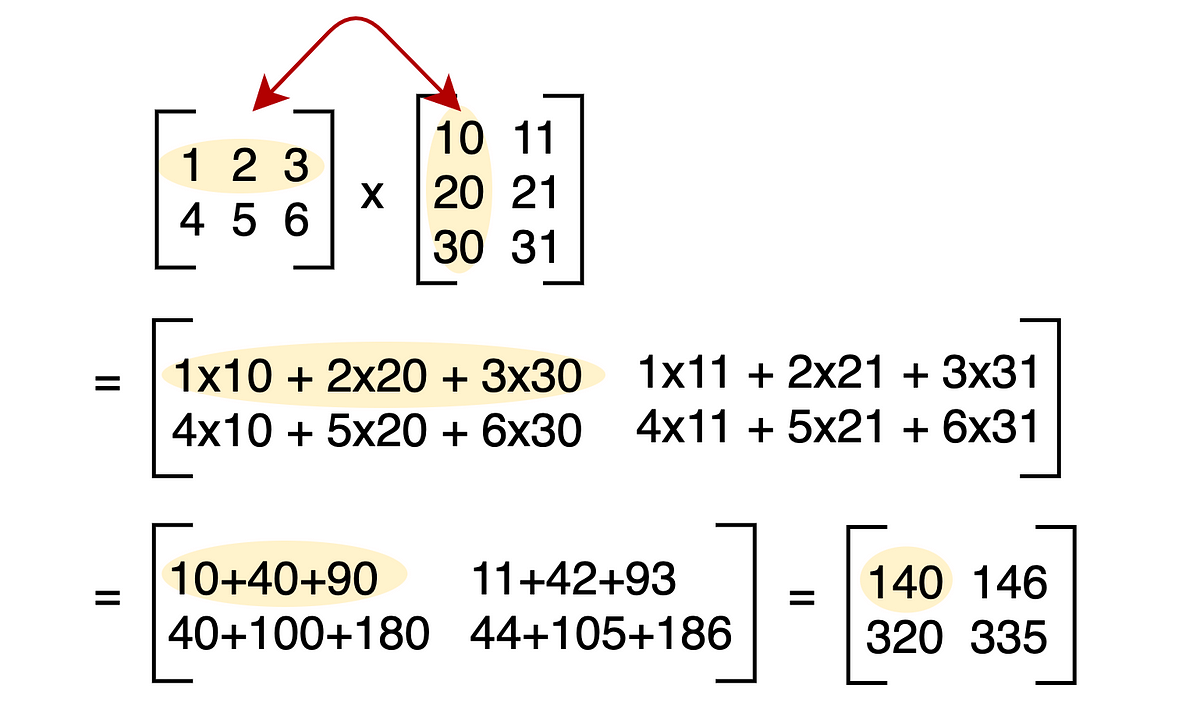
Learn matrix multiplication for machine learning by following along with Python examples

NumPy is the universal standard for working with Numerical data in Python. Multidimensional NumPy arrays are extensively used in Pandas…
The ones not covered in every How-to Guide
Make your day to day life easier by using these functions in your analysis